
What is a Construction Management Plan?
A Construction Management Plan (CMP) is a document that sets out how a construction project will be run so that its impact on neighbours, the public and the road network is controlled. It covers working hours, construction methodology, noise and dust control, waste, deliveries and site safety. In London and most major UK cities, the council must approve it, usually before work can legally start on site.
At a glance
- Required by
- Most London borough councils
- Secured through
- Application, pre-commencement condition or Section 106
- Must be approved
- Before work starts on site
- Our first drafts
- Usually 7–10 working days
On this page
In construction, CMP simply stands for Construction Management Plan. Depending on the borough you may also see the same document called a Demolition and Construction Management Plan (DMP), a Construction Environmental Management Plan (CEMP), or, in Kensington and Chelsea, a Site Construction Management Plan (SCMP). Whatever the name, the purpose is the same: a written, enforceable commitment to the council about how the build will be managed.
When is a CMP Required?
Councils secure Construction Management Plans through three routes, and it matters which one applies to your project:
- With the planning application itself. Increasingly common for larger schemes: Southwark requires a construction management plan with every major application at validation, and Kensington and Chelsea requires a draft construction traffic plan with every basement application.
- As a pre-commencement planning condition, the most common route. Permission is granted subject to a condition that no development shall take place until a CMP has been submitted to and approved in writing by the council. The condition must be formally discharged before work starts.
- Through a Section 106 legal agreement. Camden secures CMPs this way, which takes them outside the normal discharge-of-conditions process: there is no statutory determination clock, and a breach can be pursued through injunction.
The requirement now extends well beyond large-scale projects to any construction that might affect the local neighbourhood, from basement extensions beneath a single dwelling to major urban regeneration schemes. An application to discharge a pre-commencement condition currently costs £89 for householder schemes and £309 for all other development (2026 fees, with a further increase expected from December 2026). Several inner London boroughs charge substantial additional fees for reviewing and monitoring construction management under their own codes of practice.
What Does a CMP Include?
A thorough Construction Management Plan provides an overview of the construction works and assesses the potential impacts on surrounding areas. The core sections councils expect are:
- Public safety, site security and hoarding arrangements
- Site operating hours, including delivery-hour restrictions
- Detailed construction methodology, programme and phasing
- Noise and vibration control to BS 5228, with monitoring on larger sites and Section 61 consents where needed
- Dust and air quality management, including compliance with London's Non-Road Mobile Machinery (NRMM) emission rules and register
- Waste management, spoil removal and materials recycling
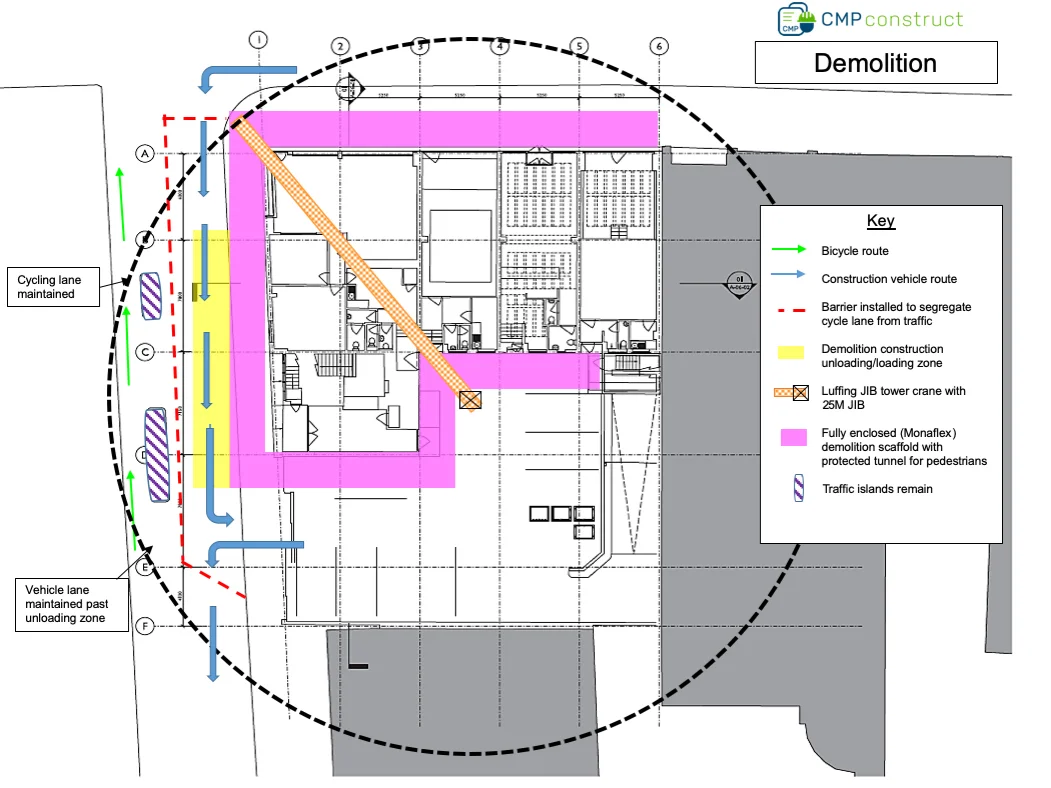
- Traffic management: agreed vehicle routes, vehicle numbers by phase, site access and swept path analysis where manoeuvres are constrained
- Neighbour communication: advance notification, a complaints procedure and, in some boroughs, formal consultation before the plan is approved
- Vehicle and driver safety standards (CLOCS / FORS) and Considerate Constructors Scheme registration where the borough requires it
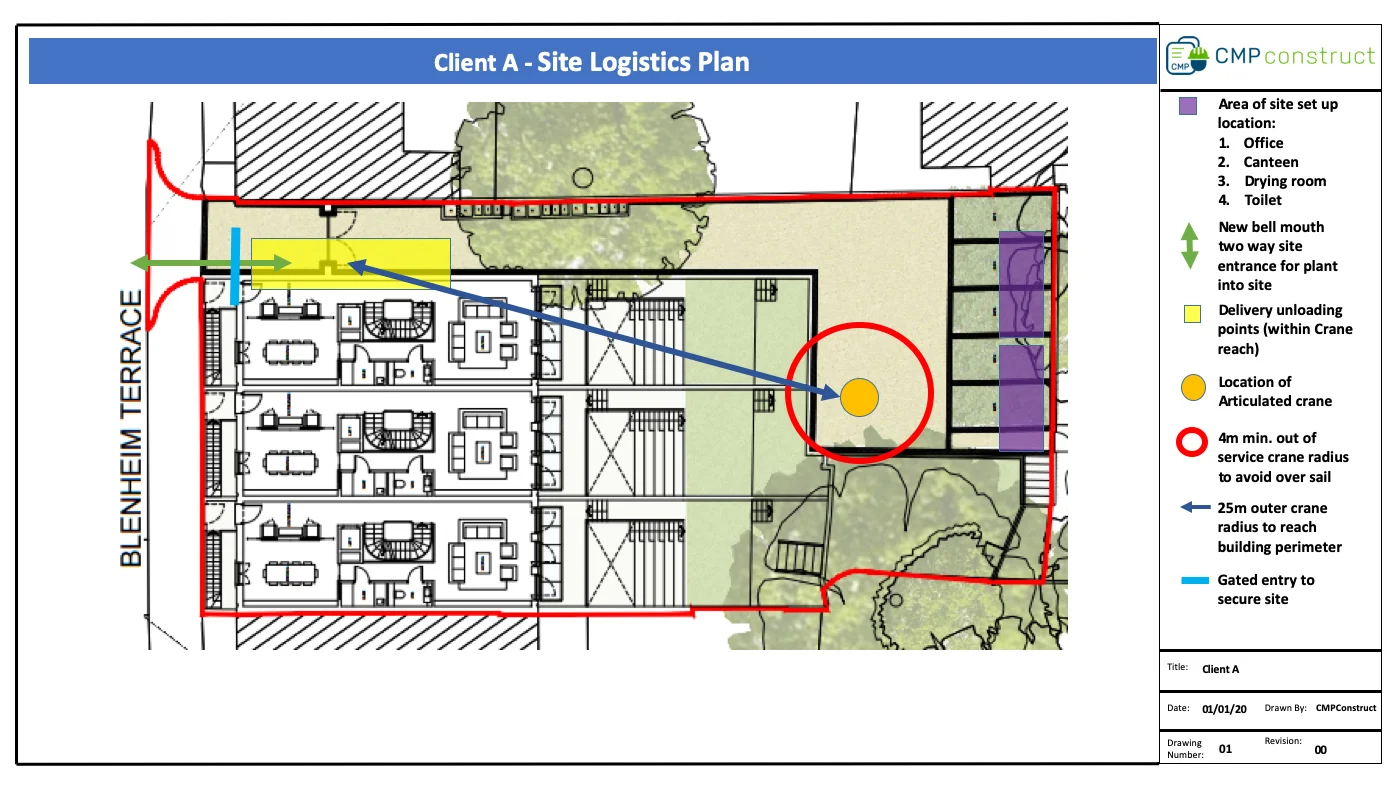
Beyond these standard elements, a CMP addresses the variables specific to each project and local authority, including specialised assessments such as noise surveys. A well-crafted CMP is not merely a compliance document: once approved it becomes enforceable, and it shapes how the project is actually delivered.
How Councils Review and Approve a CMP
A submitted CMP is typically reviewed by two or three council teams at once: planning officers coordinate the discharge, the highways team scrutinises vehicle routes, access and swept paths, and environmental health officers check hours, noise, vibration and dust controls. Transport for London is consulted where a site sits on or near a red route, or where the application is referable to the Mayor.
For condition-secured CMPs, the council has a statutory target of eight weeks to determine a discharge application, and must refund the fee if it takes more than twelve. In practice, allow longer: Camden states CMP approval typically takes 6–12 weeks or more, and Westminster and Tower Hamlets both require construction management submissions at least 40 working days before work is due to start, with the clock restarting on every resubmission. This is why we advise commissioning the CMP as soon as permission is granted, not when the contractor is ready to mobilise.
Starting work before a pre-commencement condition is discharged is unlawful development: it exposes the project to enforcement action, can undermine the lawful implementation of the permission itself, and routinely causes problems on sale or refinancing when buyers' solicitors ask for evidence of discharge.
Why Councils Reject CMPs
Most CMP refusals and resubmission cycles trace back to a handful of avoidable causes:
- Vague or hedged wording. Several boroughs state this explicitly. Richmond's guidance says words like "generally", "approximately" and "likely to be" will cause rejection, and Kensington and Chelsea's pro-forma requires the plan to read as a set of restrictions. Where detail is genuinely unknown, a robust worst case must be stated.
- Generic content, or the wrong format. Boroughs with their own pro-forma, template or checklist expect it to be used; submissions in the wrong structure can be returned unreviewed.
- Missing or inadequate drawings: no swept path analysis for constrained access, or plans not to scale.
- Unrealistic vehicle movements: officers expect phase-by-phase vehicle types, sizes and defensible maximum numbers.
- Non-compliant hours: proposing deliveries in school-run windows or works outside the borough's permitted hours without justification.
- Missing neighbour consultation where the borough requires it. Camden, for example, expects evidence that neighbours were given 14 days to comment on the draft.
- Missing supporting regimes: no dust monitoring proposal, no NRMM compliance statement, or no Considerate Constructors Scheme registration where mandated.
Permitted Construction Working Hours
The London norm is 8am–6pm Monday to Friday and 8am–1pm on Saturdays, with no working on Sundays or bank holidays, but the CMP must reflect the specific borough's rules, and several are stricter. Kensington and Chelsea bans noisy work on Saturdays entirely and restricts high-impact activities to short weekday windows; Westminster allows no Saturday piling, excavation or demolition; Tower Hamlets restricts construction vehicle movements to mid-morning and mid-afternoon windows. Delivery hours are often tighter than working hours, typically around 9.30am–4.30pm in inner London, reduced further near schools.
CMP, CTMP, CLP or CEMP: Which Do You Need?
A CMP is the broadest document, covering overall site management: hours, noise, dust, waste, safety, neighbour impact and traffic. A Construction Traffic Management Plan (CTMP) is the highways-focused subset (vehicle routing, numbers, swept path analysis, parking suspensions and marshals), and some boroughs ask for it as a standalone document. A Construction Logistics Plan (CLP) follows Transport for London's guidance and goes further on freight strategy: reducing vehicle trips, delivery booking, driver standards and safety, usually as an outline plan with the application and a detailed plan before commencement. A Construction Environmental Management Plan (CEMP) is the environmental counterpart, conditioned where a site sits near homes, schools, watercourses or protected habitats: noise and vibration, dust and air quality, water and drainage, waste, contamination and ecology, with the monitoring regime to evidence them. Your planning condition's exact wording determines which you need. We check it free of charge and advise.
How Requirements Differ Across London
No two London boroughs run construction management the same way, and plans written for the wrong regime get bounced. Westminster adopted a rewritten Code of Construction Practice in 2026 with four project levels and a 40-working-day approval clock; Camden secures CMPs through Section 106 agreements with implementation fees and bonds; Kensington and Chelsea approves an SCMP and CTMP under its Code of Construction Practice; Southwark assesses plans against detailed technical guidance with no template at all. We publish dedicated guides to the boroughs we work in most:
- Construction Management Plans in Westminster
- Construction Management Plans in Camden
- Construction Management Plans in Kensington and Chelsea
- Construction Management Plans in Southwark
- Construction Management Plans in Islington
- Construction Management Plans in the City of London
- Construction Management Plans in Lambeth
- Construction Management Plans across London
The CMPConstruct Approach to Management Plans
We believe the most effective plans are created with a thorough understanding of construction methodology. This requires visualising the future structure within its environment and developing a suitable approach that respects the site location. Our experienced construction professionals bring practical understanding to each plan, selecting methodologies appropriate for both the project and its surroundings, and writing them in the format and level of detail the specific borough's officers are used to approving.
The complexity of a CMP is typically determined by the size and nature of the building project, particularly when demolition or basement construction is involved. Regardless of scope, we adapt all elements to suit each client's specific needs and requirements, and we review each draft with our clients so the final document complements the proposed delivery approach while minimising community impact.
Timelines and Next Steps
A common question we receive is: "How long does a Construction Management Plan take?" Drafting is the quick part: most of our CMPs are completed within 7–10 working days from receiving project information to delivering the first draft for client review. Council approval is the long part: plan for two to three months between commissioning the document and a discharged condition, longer in boroughs with formal pre-commencement clocks. The safest course on any project is to commission the CMP the week permission is granted. For the other half of the same question, see what a CMP costs and what drives the price.
If you would like to learn more about our services or need a quotation for developing a Construction Management Plan for your project, contact us today for a personalised proposal. Quotations are free, fixed and provided within 48 hours. Architects and planning consultants who meet these conditions regularly can see how we work as a delivery partner instead.
Frequently Asked Questions
A Construction Management Plan (CMP) is a comprehensive document that outlines proposed building works and details how the constructor will manage the project to minimise impact on local residents. CMPs have become an essential requirement for most London councils and authorities in major cities across the UK. Councils typically require a CMP to be submitted during the planning application process or as a Planning Approval Condition that must be satisfied before work on-site can commence.
A thorough CMP provides an overview of construction works and assesses potential impacts on surrounding areas. This includes public safety and site security measures, site operating hours, detailed construction methodology and programme, noise and vibration control protocols, management of air quality, dust and site drainage, waste management and materials recycling strategies, traffic management plans including site access routes with swept path analysis, and any site-specific considerations requiring detailed assessment.
Most straightforward CMPs are completed within 7-10 working days from receiving project information to delivering the first draft for client review. For more complex projects, the CMP Construct team works alongside your project team to fully understand requirements and provide an accurate timeline estimation. We assess the entire project scope and propose an appropriate solution and realistic timeframe.
Construction Management Plans are now mandatory for virtually all construction projects across London and many other UK cities. The requirement extends beyond large-scale projects to any construction that might affect the local neighbourhood, from simple basement extensions in existing residences to major urban regeneration schemes. A properly prepared CMP is a critical document required by local authorities and serves as a pivotal component in the Planning Approval process.
In construction and planning, CMP stands for Construction Management Plan: the document councils require to show how a building project will be managed to limit its impact on neighbours, the public and the highway. Some authorities use different names for the same document: Demolition and Construction Management Plan (DMP), Construction Environmental Management Plan (CEMP), or Site Construction Management Plan (SCMP) in Kensington and Chelsea. The content and purpose are essentially the same.
No. Where a CMP is required by a pre-commencement planning condition, starting any work, including demolition on most sites, before the condition is discharged is unlawful development. It exposes the project to enforcement action, can undermine the lawful implementation of the planning permission itself, and commonly causes problems on sale or refinancing when solicitors ask for evidence of discharge. Councils also typically withhold highway licences, such as hoarding and crane licences, until the CMP is approved.
The national application fee for discharging conditions in England is currently £89 for householder schemes and £309 for all other development per request (2026 fees, with a further increase expected from December 2026). Some London boroughs charge significant additional fees for construction management review and monitoring under their own codes of practice, on top of the cost of preparing the CMP document itself. Camden, Westminster, Tower Hamlets and Kensington and Chelsea all operate paid regimes.
In addition to Construction Management Plans, CMP Construct provides Construction Traffic Management Plans (CTMPs) compliant with borough council and TfL guidelines, and Construction Logistics Plans (CLPs) for projects affecting Transport for London infrastructure. We can also coordinate essential supporting elements such as swept path analysis, noise surveys, and other specialist assessments when needed.